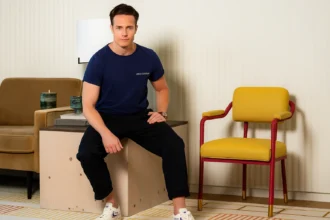

In an era defined by climate change and rapid urbanization, the call for a more thoughtful, harmonious, and sustainable approach to building our world has never been more urgent. Answering this call is a new generation of architects and designers, but few have articulated a vision as compelling and executed it with as much grace as Antonio Chi Su. More than just a name on blueprints, Antonio Chi Su represents a philosophy—a deep-seated belief that our structures should not dominate the landscape but converse with it, nurture their inhabitants, and leave a gentle footprint on the planet. His work transcends mere aesthetics, merging cutting-edge technology with timeless principles to create spaces that are not only beautiful but are actively regenerative. This deep dive into the world of Antonio Chi Su will explore the mind of a modern master, unraveling the threads of his design ethos, celebrating his most iconic projects, and understanding the profound impact he is having on the future of our global environment. To understand the movement towards truly green architecture is to understand the principles that Antonio Chi Su has championed throughout his illustrious career.
The story of Antonio Chi Su is not one of sudden fame but of consistent, principled evolution. He emerged not with a single spectacular skyscraper but with a body of work that consistently asks a simple, powerful question: “How can this building give back more than it takes?” This question has become the north star for his firm and has inspired a legion of designers, engineers, and city planners to think differently. From sprawling urban developments that function like ecosystems to intimate residential spaces that serve as personal sanctuaries, the influence of Antonio Chi Su is a testament to the power of ideas that are both profoundly simple and radically innovative. This article will journey through his life, his groundbreaking methodologies, and the legacy he is building—one sustainable brick at a time.
The Formative Years and Philosophical Foundations of Antonio Chi Su
Every great architect’s style is a mirror reflecting their experiences, studies, and the cultural milieu that shaped them. For Antonio Chi Su, this foundation was poured with a unique mix of Eastern philosophical traditions and Western technical rigor. Growing up with an appreciation for environments where nature was not a separate entity but an integral part of daily life, he developed a sensitivity that would later define his career. His academic path was equally eclectic, blending formal architectural engineering with deep dives into environmental science and even anthropology. This multidisciplinary approach is the bedrock upon which Antonio Chi Su built his entire practice; it’s the reason his buildings are not just structures but are considered living, breathing organisms within their urban or natural contexts.
This unique educational background led Antonio Chi Su to develop a core set of principles that guide every project. The first is Biophilic Integration—the idea that humans have an innate tendency to seek connections with nature. For him, this isn’t just about adding a few plants to a lobby. It’s about designing airflow systems that mimic forest canopies, using natural light as a primary material, and creating sightlines that constantly reconnect occupants with the outside world. The second principle is Radical Efficiency, a commitment to ensuring that every watt of energy, every drop of water, and every kilogram of material is used with maximum intention and minimal waste. Finally, there is the principle of Community Weaving, which posits that a building’s purpose is not fulfilled until it actively improves the social and economic fabric of the community it resides in. These aren’t just buzzwords for Antonio Chi Su; they are non-negotiable tenets.
Deconstructing the Signature Style of Antonio Chi Su
If you were to walk into a building designed by Antonio Chi Su, you would feel something before you even noticed any specific detail. There’s a palpable sense of calm, light, and harmony. This is no accident. It is the direct result of his signature design style, which can be deconstructed into several key elements. Firstly, there is a masterful manipulation of light. Antonio Chi Su treats sunlight as a fluid building material, using carefully positioned apertures, light wells, and reflective surfaces to paint interiors with dynamic, ever-changing patterns. This reduces the need for artificial lighting while creating a connection to the natural rhythm of the day and seasons, a hallmark of his human-centric design approach.
Secondly, the use of materiality in the work of Antonio Chi Su is both honest and innovative. He has a strong preference for locally sourced, natural, and reclaimed materials. You’ll often find exposed rammed earth walls, sustainably harvested timber beams, and structural elements left in their raw, finished state. This isn’t an industrial aesthetic; it’s a celebration of texture, origin, and authenticity. Furthermore, he pioneered the use of a proprietary recycled composite material made from post-consumer plastic and glass, which his firm uses for everything from decorative panels to non-load-bearing walls. This commitment to a circular economy, where waste is redesigned as a resource, is a tangible manifestation of the philosophy that Antonio Chi Su advocates for in all his public talks and writings.
Iconic Projects That Define a Career
To truly grasp the genius of Antonio Chi Su, one must look at the concrete manifestations of his philosophy—his buildings. Each project serves as a case study in solving a complex architectural problem with elegance and ecological intelligence. One of his most celebrated early works is the Canopy Tower in Singapore. This mixed-use development is famous for its “vertical forest” facade, which is more than just greenery for beauty’s sake. The specific selection of plants acts as a natural air filtration system, significantly reducing particulate matter in the densely populated district. The building’s shape was digitally modeled to optimize wind flow, creating natural ventilation that cuts air conditioning use by over 40%. The Canopy Tower wasn’t just built; it was grown, and it stands as a powerful early statement from Antonio Chi Su on the future of urban density.
Another landmark project is the Sierra Madre Retreat in California. Nestled in a protected forest, this private residence is a masterclass in disappearing into the landscape. The structure is built primarily from stone quarried on-site and timber reclaimed from a nearby fallen sequoia. Its living roof, covered in native grasses and wildflowers, blends the home seamlessly into the hillside. What makes this project quintessentially Antonio Chi Su is its water management system. The retreat captures 100% of its rainwater, filters it through a constructed wetland on the property, and reuses it for irrigation and non-potable uses, achieving complete water neutrality. It’s a testament to his belief that a home can be a self-sustaining refuge, a part of the land it occupies rather than an imposition upon it.
The Antonio Chi Su Method: A Blueprint for Sustainable Design
What sets the firm of Antonio Chi Su apart is not just the what but the how. The design process itself is a meticulously crafted ecosystem that prioritizes sustainability from the very first sketch. It begins with what he calls “Deep Site Listening.” Before any designs are drawn, his team spends weeks, sometimes months, analyzing the site. They don’t just survey the land; they study sun path trajectories across all seasons, prevailing wind patterns, native flora and fauna, hydrological flows, and even the cultural and historical significance of the location. This immense amount of data is then fed into powerful parametric modeling software, allowing the team to run thousands of simulations to arrive at a form that responds optimally to its environment. This data-driven approach ensures that the final design is inherently efficient by nature, not just by added technology.
The next phase of the Antonio Chi Su method is collaborative prototyping. He operates on a principle of “open-source sustainability,” often bringing in engineers, material scientists, and even local artisans early in the design process to co-create solutions. For instance, when designing a new cultural center in Norway, his team partnered with a local startup developing a new type of transparent solar glass. This collaboration wasn’t an afterthought; it was integral to the facade design from day one. This method fosters innovation that wouldn’t be possible in a traditional, linear design-bid-build model. It ensures that every element, from the macro form to the micro detail, is infused with the shared goal of creating a building that is a net-positive contributor to its environment, a core mission for Antonio Chi Su and his entire team.
The Ripple Effect: Influence on Modern Architecture and Urban Planning
The impact of a visionary like Antonio Chi Su is never confined to his own portfolio. His work has created a ripple effect, challenging and inspiring the entire field of architecture and urban planning to raise its standards. He has demonstrably proven that high-performance, sustainable buildings are not only feasible but can be economically viable and stunningly beautiful. This has moved the conversation from “why should we build green?” to “how can we build better than green?” Developers and city councils who once saw sustainability as a costly add-on now see it as a valuable differentiator and a long-term economic imperative, thanks in large part to the compelling case studies provided by the work of Antonio Chi Su.
Furthermore, his advocacy for policy change has been just as influential as his buildings. Antonio Chi Su has served as a key advisor to numerous city governments around the world, helping to rewrite building codes to incentivize green roofs, rainwater capture, and energy-positive design. He has been a vocal proponent of densification done right—arguing for vibrant, mixed-use, walkable communities that reduce reliance on cars and foster a sense of place. His philosophy has helped shape the development of entire districts, turning them into models of sustainable urban living. This broader influence shows that the vision of Antonio Chi Su extends far beyond the walls of any single building; it is about reprogramming the DNA of our cities for a more resilient and equitable future.
Overcoming Challenges and Criticisms
Pioneering a new path never comes without obstacles, and the career of Antonio Chi Su has had its share. In the early days, the biggest challenge was convincing clients to invest in unproven technologies and methodologies. The upfront costs for some of his integrated systems were higher than conventional alternatives, and he faced skepticism from traditional developers who were risk-averse. Antonio Chi Su overcame this not through compromise, but by developing sophisticated financial models that clearly illustrated the long-term operational savings and increased property values his designs would deliver. He turned sustainability from a perceived cost center into a demonstrable value proposition.
Another common criticism, often leveled at high-concept sustainability, is that it can lead to a certain aesthetic homogeneity—a “green international style.” Some early critics argued that the intense focus on performance could come at the expense of cultural context and artistic expression. Antonio Chi Su has addressed this critique head-on by ensuring his “Deep Site Listening” process includes a deep cultural dive. His projects in Southeast Asia, for example, incorporate passive cooling techniques inspired by ancient vernacular architecture, while his projects in Scandinavia reflect the minimalist, light-oriented sensibilities of the region. He has successfully argued that true sustainability is culturally responsive; a building that ignores its cultural environment is as unsustainable as one that ignores its physical one. This nuanced approach has silenced many critics and enriched his body of work.
The Future According to Antonio Chi Su
So, what does the future hold according to the mind of Antonio Chi Su? He is looking beyond individual buildings toward the concept of the regenerative city. This is an urban model that functions not just efficiently, but like a natural ecosystem. It would produce its own energy, manage its own waste as a resource, actively clean its air and water, and increase its biodiversity. Antonio Chi Su and his research lab are currently experimenting with bio-reactive facade panels that use algae to capture carbon dioxide and generate biomass for energy, a technology he believes could turn every skyscraper into a power plant and a carbon sink.
Furthermore, he is deeply invested in the democratization of sustainable design. A key future project for Antonio Chi Su is the development of an open-access digital platform—a kind of wiki for sustainable construction. This platform would provide architects and builders everywhere, especially in developing regions, with free access to proven designs for passive cooling systems, low-cost water purification wetlands, and details for using local, sustainable materials. His goal is to ensure that the principles of good, resilient, and eco-conscious design are not a luxury for the few but a standard practice for all. This vision for a collaborative, open-source future is perhaps the most exciting legacy Antonio Chi Su is working to build.
How to Incorporate Antonio Chi Su’s Principles into Your Own Space
You don’t need to commission a multi-million dollar building to embrace the ideas championed by Antonio Chi Su. His principles can be applied at any scale, from a single-family home to a small apartment renovation. Start with light and air. Observe how sunlight moves through your space throughout the day. Can you rearrange your living areas to take advantage of natural light and reduce your dependence on electric lights? Can you improve cross-ventilation with strategically placed windows or vents to catch breezes? These simple, passive strategies are the first step toward a more efficient and healthy home, a core tenet of the philosophy that Antonio Chi Su promotes.
Next, consider your materials and resources. When renovating or decorating, seek out low-VOC paints, reclaimed wood furniture, and natural textiles like wool and cotton instead of synthetics. Think about the lifecycle of everything you bring into your home. Finally, embrace biophilia. Introduce plants that improve indoor air quality. Create a small herb garden on your windowsill. Use natural materials like wood and stone in your decor. Even hanging artwork depicting natural scenes can have a positive psychological effect. The goal is to create a conscious connection with the natural world, making your personal space a small-scale reflection of the grand vision that Antonio Chi Su brings to his architectural projects.
Conclusion
Antonio Chi Su is far more than an architect; he is a philosopher, an innovator, and a provocateur for a better-built world. In a discipline often caught between the nostalgia of the past and the cold utilitarianism of pure modernism, he has carved out a third path—one that is forward-looking yet deeply humane, technologically advanced yet profoundly natural. His work stands as living proof that we do not have to choose between aesthetic beauty, human well-being, and ecological responsibility; in fact, each one reinforces the other. The legacy of Antonio Chi Su is not just in the stunning skylines he has helped shape, but in the minds he has changed and the higher standard he has set for us all. He has given us a blueprint, not just for buildings, but for a more thoughtful and sustainable future, and it is now our collective responsibility to build upon it.
Frequently Asked Questions (FAQs)
What is Antonio Chi Su most famous for?
Antonio Chi Su is most famous for being a leading visionary in the field of sustainable and regenerative architecture. He is renowned for his philosophy that buildings should actively improve their environment rather than just minimize harm. His fame stems from iconic projects like the Canopy Tower in Singapore, which integrate advanced eco-technology with biophilic design principles to create structures that function like living ecosystems. The name Antonio Chi Su has become synonymous with a holistic, data-driven, and deeply ethical approach to design.
Thomas Boone Quaid: The Life of Dennis Quaid’s Son
How did Antonio Chi Su get started in architecture?
Antonio Chi Su began his journey with a uniquely multidisciplinary education. He studied architectural engineering to understand the technicalities of building but simultaneously pursued deep studies in environmental science and philosophy. This blend of rigorous technical knowledge and a profound ethical framework laid the groundwork for his career. He started his own firm with a clear mandate to reject conventional practices and pioneer a new, ecologically responsible model for architecture, which has since defined his life’s work.
What are the core design principles of Antonio Chi Su?
The core design principles championed by Antonio Chi Su are Biophilic Integration, Radical Efficiency, and Community Weaving. Biophilic Integration focuses on creating an innate connection between occupants and nature through light, air, and greenery. Radical Efficiency demands that every resource—energy, water, material—is used with maximum intention and zero waste. Community Weaving ensures that every project strengthens the social and economic fabric of its surrounding area, making the building a net-positive contributor to its community.
Can the ideas of Antonio Chi Su be applied to existing buildings?
Absolutely. While Antonio Chi Su is known for new constructions, his principles are highly applicable to retrofitting existing structures. This can include upgrading insulation and windows for energy efficiency, installing green roofs or living walls, implementing rainwater harvesting systems, and reconfiguring interior layouts to maximize natural light and ventilation. The fundamental goal is to move the building’s performance closer to the regenerative ideals that Antonio Chi Su advocates, regardless of its original design.
Where can I learn more about the projects of Antonio Chi Su?
The best place to learn about the complete portfolio of Antonio Chi Su is through the official website of his architecture firm, which features detailed case studies, project descriptions, and philosophical essays. Additionally, many of his keynote speeches and lectures are available on video platforms, where he eloquently discusses his vision for the future of cities and design. Several prominent architecture and design publications also feature in-depth articles and interviews exploring the work and impact of Antonio Chi Su.